
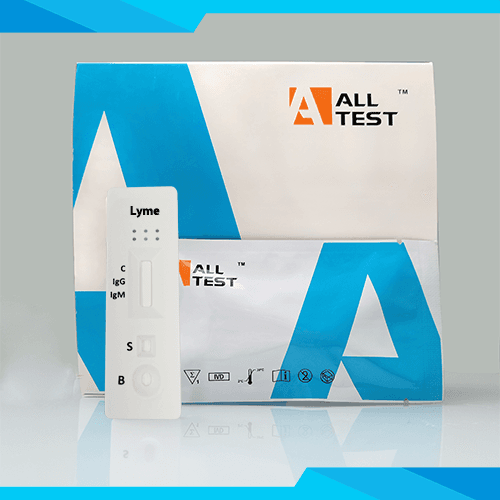
Lyme Disease IgG/IgM Rapid Test Cassette
A rapid lateral flow test for the qualitative detection of IgG and IgM antibodies to Borrelia, the bacteria that cause Lyme disease, in human whole blood, serum or plasma. Read in 10 minutes, with separate IgG and IgM result lines. Lyme disease is spread by infected ticks. Antibodies take time to develop, so blood tests are often negative in the early stages of infection, and a negative result never rules out Lyme disease if symptoms persist. Diagnosis is based on symptoms, history of tick exposure and possibly laboratory testing.
Intended use
Qualitative detection of IgG and IgM antibodies to Borrelia in human whole blood, serum or plasma as an aid in the diagnosis of Lyme disease.
This is a screening test intended to support, not replace, professional medical advice. Please consult a doctor about your results.
What this test measures
IgM antibodies are usually the first the body makes after infection with Borrelia, followed by IgG antibodies in the weeks after. This test looks for both, with a separate result line for each.
What’s in the box
Everything you need is included — nothing else to buy.
- 1×Test Casette
- 1×Safety Lancet
- 1×Buffer
How you do it
No lab, no appointment, nothing to post. Most people finish the sample step in under two minutes.
- 1Bring everything to room temperature—
Let the cassette, sample and buffer reach 15–30°C. Open the pouch only when ready and use the cassette as soon as possible.
- 2Prick your finger30 sec
Wash and dry your hands, then prick the side of a fingertip with a sterile lancet and wipe away the first drop.
- 3Add your sample and buffer1 min
Add 1 drop of whole blood (approx. 10 µl) to the specimen well (S), then add 3 drops of buffer (approx. 120 µl) to the buffer well (B) and start the timer.
- 4Wait, then read the result10 min
Read the result at 10 minutes. Do not interpret the result after 20 minutes.
How accurate it is
Figures below are taken directly from the manufacturer’s instructions for use.
| Sensitivity | 94.4% — how often it correctly identifies people who do have the marker |
|---|---|
| Specificity | 98.9% — how often it correctly clears people who don’t |
| Detection threshold | IgG and IgM antibodies to Borrelia |
| Source | Manufacturer IFU (ILY-402, rev. 2023) vs commercial ELISA. IgG: sensitivity 95.5%, specificity 98.9%, accuracy 98.2% (112 specimens). IgM: sensitivity 94.4%, specificity 98.9%, accuracy 98.1% (108 specimens). Figures shown are the lower of the IgG/IgM values. |
No rapid test is perfect. A screening result should always be confirmed by a healthcare professional.
What your result will mean
Worth knowing before you test, not after.
IgG line, IgM line, or both lines appear alongside the control line. Antibodies to Borrelia have been detected. This is not a diagnosis of Lyme disease. Take the result to a GP, who can arrange confirmatory laboratory testing.
Only the control line appears. No IgG or IgM antibodies to Borrelia were detected. A negative result does not rule out Lyme disease, particularly in the early weeks after a tick bite. If symptoms persist, speak to a GP.
If no line appears in the control (C) region, the test has not run correctly, usually because of insufficient sample or a procedural error. Repeat with a new test cassette.
Storage & preparation
Store sealed at 2-30°C. Do not freeze.
Questions people ask
What if the result is positive?
A positive screening result isn't a diagnosis — it means further testing is worthwhile. Take the result to a GP, who will arrange a confirmatory laboratory test. Screening tests are deliberately sensitive, so a positive result is a strong reason to get checked properly rather than a certainty either way. Finding out early almost always gives you more options, not fewer.
I'm nervous about testing at all. Is that normal?
Yes, and it's the most common reason people put testing off. It can help to know that a test only tells you something that is already true — it doesn't change your situation, it just gives you the chance to act on it. You can also test with someone you trust nearby, and you don't have to read the result alone.
What if I make a mistake doing the test?
The most common issue is not getting enough sample, which usually shows up as an invalid result with no control line. If that happens the test hasn't run correctly and the result shouldn't be interpreted — you'll need to order another test to get a valid result. Following the instructions in the pack carefully is the best way to avoid this.
Will the packaging show what I've ordered?
No. Everything is dispatched in plain outer packaging with nothing on the label indicating the contents. Your card statement shows only "Seradiag" and an order number, and our emails never name the tests you've bought.
Are these the same tests a clinic would use?
They are CE marked in-vitro diagnostic tests from established manufacturers, in many cases the same devices used in professional settings. The difference is usually the packaging and the instructions, which are written for self-testing rather than clinical use.
How accurate are the tests?
Accuracy figures are published on each product page, taken directly from the manufacturer's instructions for use. No rapid test is perfect: results can be affected by how and when the test is taken, and by individual biological factors. That is why every result — particularly an unexpected one — should be discussed with a healthcare professional.
Can I return a test if I change my mind?
Yes, if the seal is unbroken — within 14 days. Once a kit has been opened it can't be returned for hygiene reasons, which is a legal exception for sealed health products. Faulty, damaged or expired kits are always refunded, opened or not.
How quickly will it arrive?
Delivery options and timescales are shown at checkout. Orders placed before 2pm on a working day are dispatched the same day. If you need a result quickly, choose a faster delivery option at checkout.
Do I need to send anything to a laboratory?
No. These are self-contained rapid tests that you read yourself at home, usually within 5 to 15 minutes. Nothing is posted anywhere, and we never see or store your results.
Who are Seradiag?
Seradiag Ltd is a UK company (registered number 14428934) supplying CE marked diagnostic tests. If you have a question before ordering, email us — we would rather help you choose the right test than sell you the wrong one.